Why old trucks make great EVs
Older pickups might be the best vehicles there are to convert to electric. They're simple, they're body-on-frame, and there's room in the engine bay and under the bed for motors and battery modules. There's no web of computers to fight with, and the trucks themselves are worth keeping. The frame, body, and cab you already love stay; the engine, exhaust, and gas tank go.
Our own truck is a 1986 Ford Ranger we converted and drive every day, so everything below comes from doing it, not reading about it.
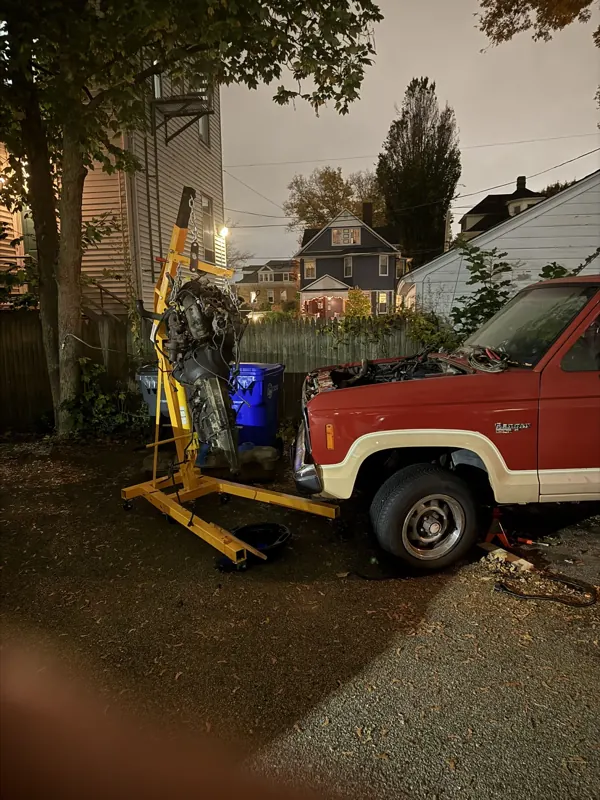
Which trucks convert well
- Compact and mid-size pickups — Ford Ranger, Chevy S-10, Toyota and Nissan pickups, Mazda B-series. Light trucks need smaller packs for useful range, which keeps cost down.
- Manual transmissions — the motor mates to the existing bellhousing and the gearbox stays. An automatic can be converted, but swapping in a manual adds real cost.
- Solid frames — in New England, rust decides more conversions than anything else. The frame has to carry battery weight for years, so it gets inspected first.
- Full-size trucks — older full-size pickups work too, but they're heavier and usually need a larger pack and a bigger motor to feel right.
What changes in a truck conversion
Motor and inverter
An AC motor and matching inverter replace the engine. Sizing depends on the truck's weight, how it's driven, and whether it tows.
Battery pack
Modules go where the engine, fuel tank, and spare space used to be — under the hood, between the frame rails, or under the bed — in enclosures built for that truck. Pack size sets range and is usually the largest cost in the build.
Battery management and safety
A BMS watches every cell, contactors and fuses protect the high-voltage system, and the HV side is isolated from the chassis.
Charging
An onboard charger and a J1772 or NACS charge port let the truck charge at home or at public Level 2 stations.
Everything the engine used to run
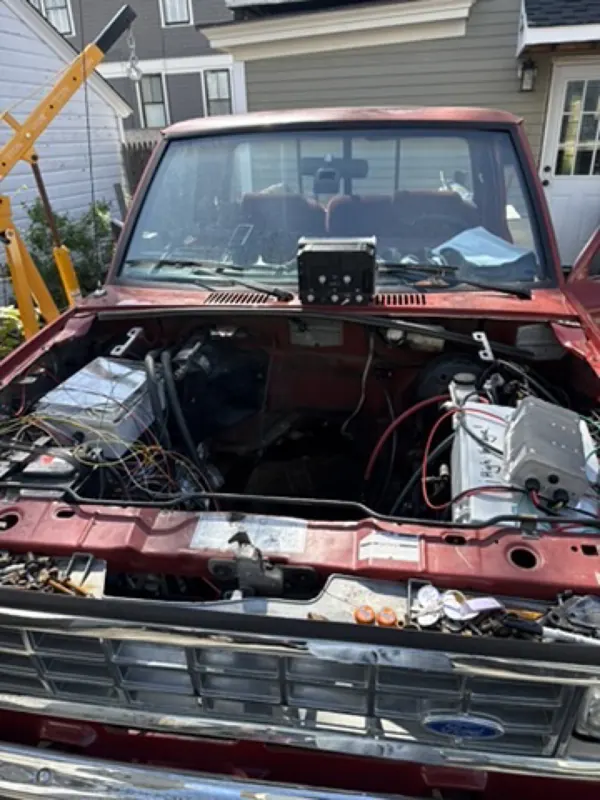
Power steering, brake vacuum, heat, AC, and 12V charging all came off the engine. Each needs an electric replacement — on our Ranger that meant an electro-hydraulic power steering pump and a DC-DC converter for the 12V system.
Towing, payload, and range
Batteries are heavy, and that weight counts against payload. Towing takes a lot more energy than driving empty, so a truck that needs to tow needs a bigger pack and a motor sized for it. We'd rather size it honestly up front than hand back a truck that disappoints on its first trailer.
Range depends on pack size, weight, and aero — and pickups are not aerodynamic. We estimate range for your specific truck during the spec step instead of promising a number.
What drives the cost
There's no flat price for an electric truck conversion. The battery pack, motor and inverter, transmission situation, fabrication, and the accessories that need electric replacements all move the number. The cost breakdown on our homepage goes line by line.
Full build, help with your build, or just parts
We do complete truck conversions in Rhode Island for owners across New England and the Northeast. If you're converting your own truck, we can help with component selection, wiring, and BMS and CAN commissioning, or put together a full parts list.